Every Event Has a Moment of Truth. Here's How We Handle Ours.

In 12 years of producing corporate events in the Pacific Northwest, we've never had to invoke our "Flawless or We Waive the Fee" guarantee. Not once.
That's not because nothing has ever gone wrong at an event. It's because the things that go wrong are handled before the audience notices. Redundancy, preparation, and experienced crew make the difference.
Here's what goes into preventing issues before they become problems.
Redundancy Is Built In
Every event we produce includes multiple layers of protection:
Layer System What It Prevents
Power Dual-feed capability with UPS switchover Equipment shutdown during circuit interruptions
Audio Dual-receiver diversity on all wireless mics. Signal dropouts from interference or body positioning
Video Backup switcher and signal distribution Display failure during critical presentations
Network Primary broadband + cellular fail over Live stream interruption during hybrid events
Crew Lead technician + system tech on-site Single-point failure in personnel coverage
Pre-Event Preparation Protocol
The work that prevents failures happens before the event begins:
Phase Timeline Activity Purpose
Site Survey. 14 days out Venue walk through, power audit, RF scan Identify potential issues before they exist
Gear Prep 3 days out Equipment pull, bench test, firmware check Verify every unit functions before load-in
System Design 7 days out Computer-modeled speaker coverage map. Eliminate dead spots and coverage gaps
Crew Briefing. 2 days out. Run of Show review, role assignment Every crew member knows their responsibilities
Sound Check Event day Full system test. Confirm performance before doors open
RF Coordination: The Invisible Work
Wireless microphone interference is the most common issue at corporate events. Most attendees never notice it because competent audio engineers resolve it before the event starts.
Our RF coordination process:
- Pre-show frequency scan within 2 hours of doors opening
- Full spectrum analysis identifying occupied channels from broadcast TV, emergency services, and other venue RF users
- Frequency coordination locking all wireless mics to verified clear channels
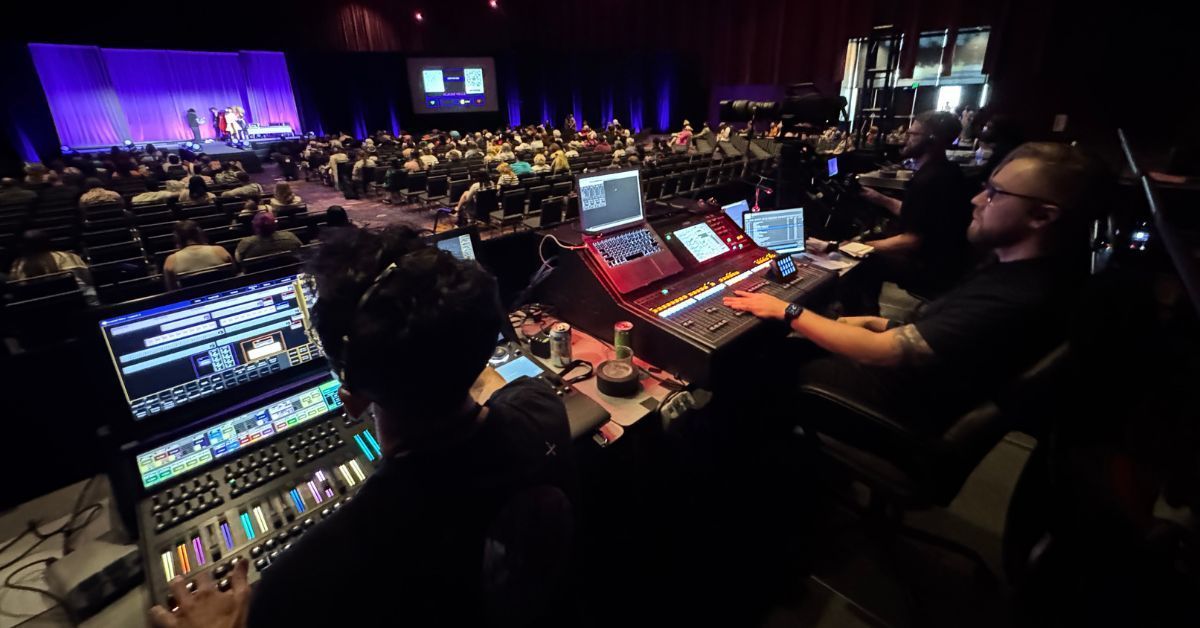
- Active monitoring during the event with spectrum analyzer running at FOH position
At a 50,000-person Fourth of July celebration in Seattle, we managed wireless microphones across three stages in one of the most RF-dense environments in the Pacific Northwest. Zero interference incidents. That's not luck — it's hours of pre-show frequency mapping by a systems engineer who understands the RF environment.
What to Ask Your AV Vendor
When evaluating whether a vendor can prevent issues (not just react to them):
- "What's your pre-event preparation process?"
- Look for: Site survey, gear testing, crew briefing, RF scan
- Red flag: "We show up and set up"
- "How do you handle wireless microphone frequency coordination?"
- Look for: Pre-show scanning, spectrum analysis, licensed frequencies
- Red flag: "We just turn them on and pick a channel"
- "What redundancy is built into your standard package?"
- Look for: Dual receivers, backup mixers, UPS power, spare inventory
- Red flag: "We have extra stuff in the truck"
- "What's your track record?"
- Look for: Specific numbers, years in business, guarantee history
- Red flag: Vague claims about "experience"
- "Can you share your Run of Show template?"
- Look for: Documented timeline, crew assignments, contingency notes
- Red flag: "We keep it in our heads"
The Track Record
Metric Value
Years in business 12.
Corporate events produced 150+
Guarantee invocations 0
Average crew experience 10+ years
Standard protocol Computer-modeled planning, RF coordination, dual-receiver diversity
Prevention isn't a marketing claim. It's a documented process applied to every event. The result speaks for itself: 150+ corporate events, zero guarantee invocations.